OpenLAND will explore how changes in UK land use could create benefits for net zero targets, soil health, biodiversity and agriculture.
Researchers at the Tyndall Centre for Climate Change Research and the School of Environmental Sciences at the University of East Anglia (UEA), are leading a major new research project under the Land Use for Net Zero (LUNZ) Hub, identifying spatially explicit land-use scenarios that provide carbon storage, while benefitting soil carbon and soil health, nature recovery, and sustainable crops.
OpenLAND aims
Articles
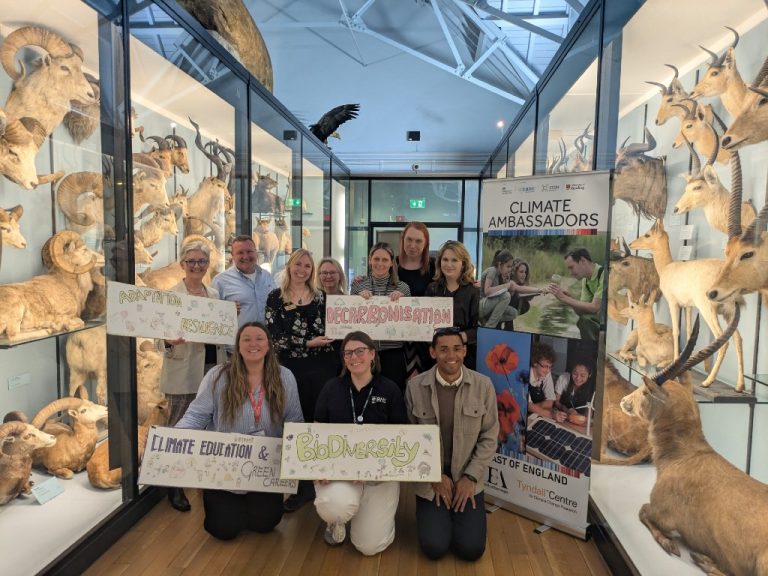
OpenLAND team
OpenLAND will provide decision makers with the insights urgently needed to put the UK on a path to deliver net zero emissions by 2050, while also delivering climate-resilient soil health, food security, and biodiversity net gain.
“We will identify climate-resilient UK land-use pathways to achieve net zero, biodiversity net gain, sustainable crop supply, and safeguard against floods and droughts, under a changing climate.” -Professor Rachel Warren
OpenLAND will quantify the implications of land interventions on soil carbon and health, biodiversity, agriculture, and flood risk, while exploring the synergies and trade-offs between interventions. Potential land use interventions include ecosystem restoration and sustainable agriculture.
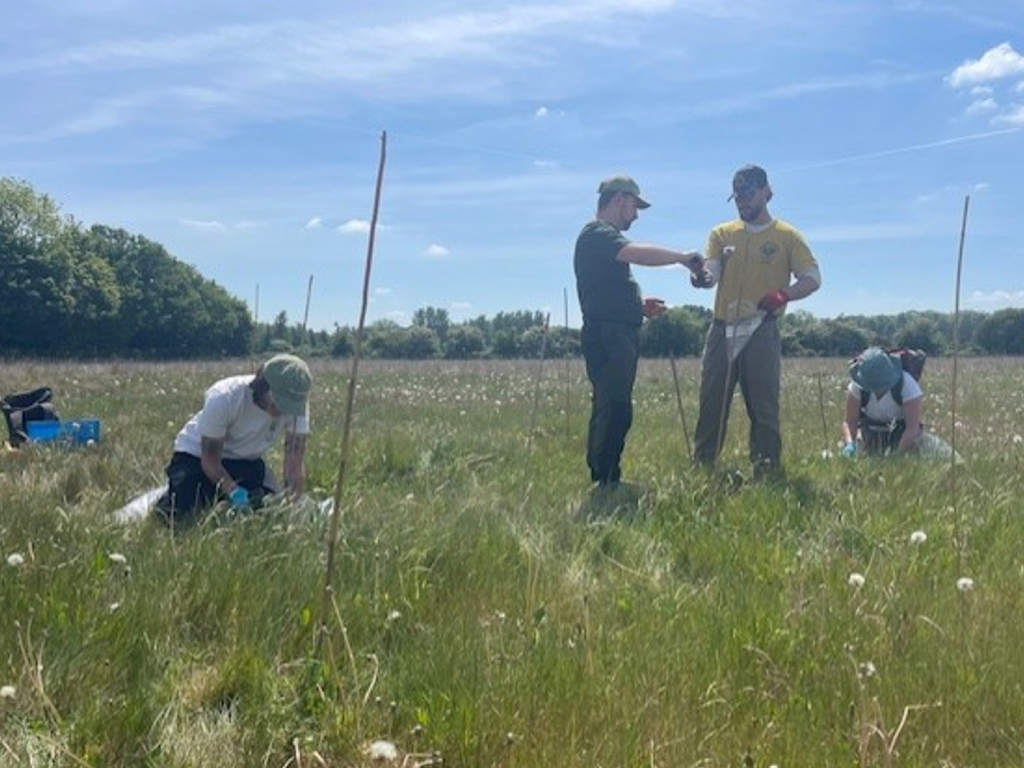
To extend the capability of the research project OpenCLIM (developed under previous UKRI funding), we will develop and validate a novel framework for the effective land-use interventions upon carbon storage, particularly focusing on soil carbon and soil health evaluation. This will be achieved by ground truthing soil carbon and soil health using empirical data, and by developing and trialling robotic monitoring for measuring and verifying soil carbon and health.
This will allow data relating to soil carbon and long-term carbon storage potential to feed into OpenLAND to give real-world evaluation of below-ground carbon dynamics under land-use intervention scenarios. It will also enable soil microbiome data, as a qualifier of soil health, to be reconciled with OpenCLIM’s projections for the terrestrial biosphere.
The project will culminate in the identification of new, spatially explicit intervention scenarios for land-use interventions to exploit synergies and minimise trade-offs. We define scenarios as plausible spatial realisations that do not attempt to predict the future but to gain an understanding of the range of uncertainties of potential pathways and impacts of land use and/or land cover change.
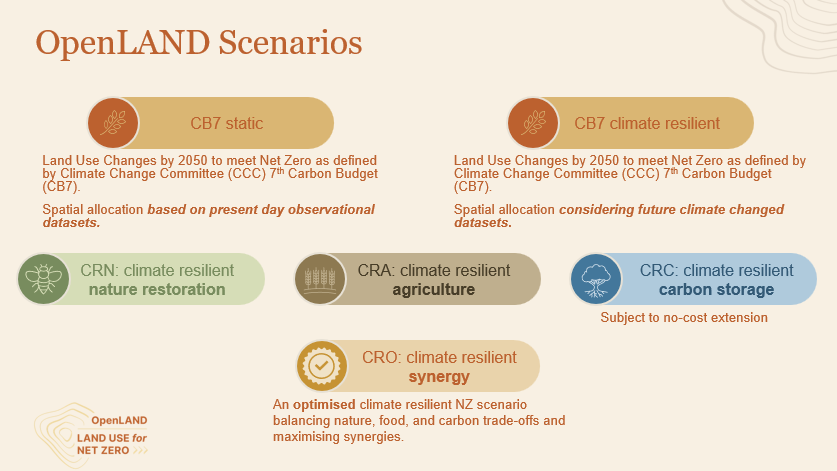
OpenLAND has four aims:
1: Create a validated, UK-wide, spatially explicit integrated modelling framework, OpenLAND, to evaluate potential net zero pathways
We will co-develop a database of potential land-use interventions with stakeholders, adapt existing model codes to respond to land-use interventions, and make available data and models within our modelling framework.
2: Upscale soil carbon and soil health empirical data to calibrate the OpenLAND framework at UK level
We will ground truth soil carbon and soil health under a range of land-use change interventions and Greenhouse Gas Removal strategies, develop and validate a novel framework for soil carbon and soil health evaluation, and develop and trial robotic monitoring for measuring and verifying soil carbon and health.
3: Explore the synergies and trade-offs associated with alternative land use interventions
We will quantify the implications of potential land-use interventions on soil carbon and health, biodiversity, agriculture, and flood risk, and use the framework to co-develop with stakeholders, new pathways to net zero on land in the UK that exploit synergies between carbon sequestration, soil health, agricultural productivity, biodiversity conservation and climate resilience.
4: Engage with farming groups and academics to develop win-win net zero solutions
We will liaise with stakeholders at workshops, discussion groups and in the field, create project database and user-facing decision support tools, and through close stakeholder engagement will provide the opportunity for governments, agencies, and NGOs to engage with farming groups and academics to develop win-win net zero solutions.
Articles
Chapman, J. and Reid, B. (2025) Regeneratively farmed is the new buzz label on supermarket shelves – but what does it actually mean? Available at: theconversation.com/regeneratively-farmed-is-the-new-buzz-label-on-supermarket-shelves-but-what-does-it-actually-mean-247437 (Accessed: 22 January 2025)
Duncan, A., Koon, W., Sidorczuk, K., Quince, C., Frioux, C., Hildebrand, F., (2025). Detecting signatures underlying the composition of biological data. Nucleic Acids Research, 53 (22), https://doi.org/10.1093/nar/gkaf1388.
Sayers, P.B., Birkinshaw, S.J., Carr, S., He, H., Lewis, L., Smith, B., Redhead, J., Pywell, R., Ford, A., Virgo, J., Nicholls, R.J., Price, J., Warren, R., Forstenhausler, N., Smith, A.J.P., Russell, A. (2025). A National Assessment of Natural Flood Management and Its Contribution to Fluvial Flood Risk Reduction. Journal of Flood Risk Management, 18 (4), https://doi.org/10.1111/jfr3.70151.
The OpenLAND Team
The project will be jointly led by Rachel Warren (Professor of Global Change and Environmental Biology, Tyndall Centre) and Brian Reid (Professor of Soil Science, UEA).
OpenLAND will align researchers at:
- Tyndall Centre UEA (Jeff Price, Nem Vaughan, Li Mao, Helen He, Nicole Forstenhaeusler, Asher Minns, Adam Smith, Caridad Ballesteros Martinez, Andrew Lovett)
- UEA (Sam Keenor, Laura Conway)
- University of Plymouth (Will Blake, Claire Kelly, Jennifer Rowntree, Nicola Mansfield, Riley Kent)
- Sayers & Partners (Paul Sayers)
- Earlham Institute and Quadram Institute (Chris Quince, Falk Hilderbrand, Kaden Mufett)
- Science and Technology Facilities Council (Bethan Perkins, Elizabeth Mamtsits)
- UK Centre for Ecology and Hydrology (Richard Pywell, John Redhead, Emma Gardner, Claudia Acerini, Zephyr Orsler)
- Newcastle University (Alistair Ford, Jingyan Yu, Craig Robson)
- The British Trust for Ornithology (James Pearce-Higgins, Jenni Border, Naomi Housego)
- University of Leeds (Jason Lowe)
- The Royal Society for the Protection of Birds (Tom Finch)
Our project has extensive stakeholder alignment through its partners and project networks with DEFRA, DESNZ, CCC, JNCC, Environment Agency, Nature Scotland, Natural England, DAERA, land managers, farming groups, and the ELM Network+.