
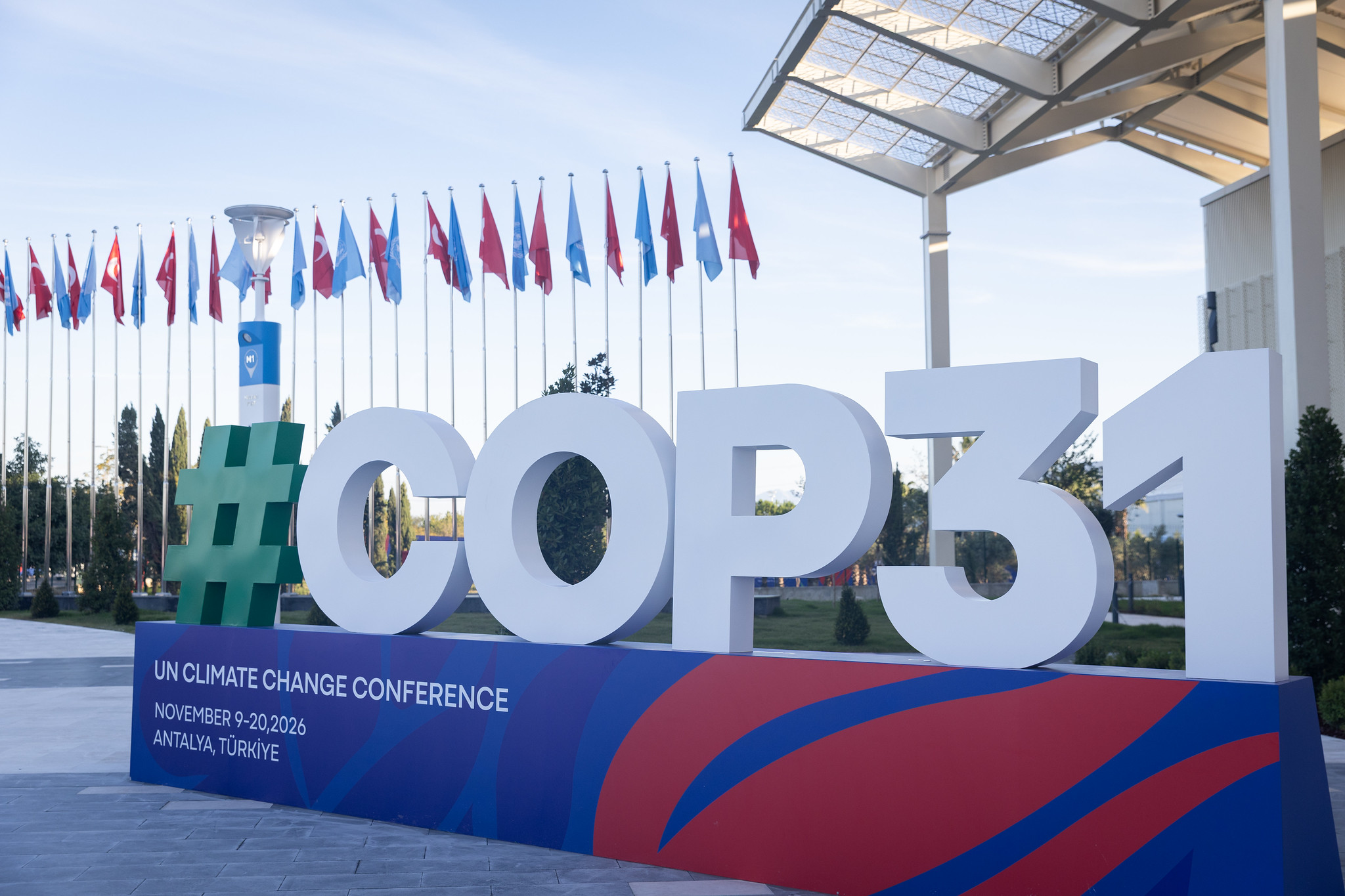
Researchers from across the Tyndall Centre for Climate Change Research will contribute evidence, analysis and discussion at COP31, with events spanning climate resilience, cities and culture, the Global Stocktake, and the latest Global Carbon Budget findings.
Next week, governments, researchers and civil society will gather for COP31, the 31st session of the Conference of the Parties (COP) to the United Nations Framework Convention on Climate Change (UNFCCC), taking place in Türkiye from 9 to 20 November 2026.
Researchers from across the Tyndall Centre partnership will share their analysis and expertise on climate resilience, adaptation, emissions trends and pathways for climate action.
Here are the events and research activities to look out for, throughout the conference – bringing evidence and insights to international climate policy conversations.
Tyndall Centre at COP31: key dates
Global Carbon Budget 2026
The latest Global Carbon Budget 2026, presented by Professor Corinne Le Quéré from the University of East Anglia (UEA), will provide the most up-to-date assessment of global CO₂ emissions and carbon sinks, helping to track progress towards the goals of the Paris Agreement.
The session will also explore how Satellite Earth observation data informs both emissions tracking and climate adaptation efforts.
Speakers will include IPCC TSU (Singapore), developing country experts, European Commission, JAXA (Japan), ESA (Italy), CEOS (tbc), as well as the Global Carbon Project team.
> See last year’s news story on the Global Carbon Budget
State of Wildfires: the latest data
The latest State of Wildfires report will be released during COP31. Published annually, the report provides an evidence-based assessment of global wildfire activity and trends.
The report will be discussed as part of wider COP31 engagement activities, contributing evidence around climate impacts, resilience and adaptation.
The report is co-led by UEA’s Dr Matthew Jones (Senior Research Fellow at the Tyndall Centre) and brings together contributions from the UK Centre for Ecology and Hydrology (UKCEH), UK Met Office, and the European Centre for Medium-Range Weather Forecasts (ECMWF), as well as world-leading experts from more than 60 institutes across 20 countries.
> Find out more about the State of Wildfires Report
Side-event: Building resilience through early action
This COP31 side event will explore how investing in comprehensive resilience results in the biggest gains for climate-exposed communities. This will involve looking at innovative approaches to resilience financing, examining how predictable funding mechanisms and early interventions can help reduce loss and damage while supporting long-term sustainable development.
‘Cascading Risk to Financing Climate-Resilient Returns: Early Action and Anticipatory Action in Africa and Beyond’ brings together researchers, policymakers, development institutions and investors to generate practical policy recommendations and highlight partnership and investment opportunities.
The event is co-organised by IGAD, the Islamic Development Bank (IsDB), the Global Network of Civil Society Organizations for Disaster Reduction (GNDR), the Inter-American Institute for Cooperation on Agriculture (IICA), and UEA (specifically, Caroline King-Okumu, Senior Research Associate at the Tyndall Centre). Other partners include CLARE (Climate Adaptation & Resilience), Global Research and Technology Department, IDRC / CRDI, and the Risk-Informed Early Action Partnership (REAP).
> Download the event flyer (.png)
> Download concept note (PDF)
Side-event: Informing the next Global Stocktake
Led by Gaurav Gharde from the University of Manchester, ‘Science Lessons from GST-1: Ambition, Equity and Sub-national Action for GST-2’ will reflect on lessons from the first Global Stocktake, which revealed gaps between technical findings, political outcomes and implementation.
The event will also explore how the second Global Stocktake and future assessments can better address equity, just transition, and the role of local and sub-national actors in climate action.
Organisers come from the University of Geneva, Universidad Politécnica de Cataluña (UPC), and the University of Technology Malaysia (UTM), as well as the University of Manchester. Speakers include policymakers at national and sub-national levels, climate governance researchers, and practitioners and civil society involved in Global Stocktake follow-up considering the balance between Global North and South and gender.
Cities, culture and climate action
Professor Carly McLachlan from the University of Manchester will contribute to discussions on the role of cities in accelerating climate action through the cultural sector and civic engagement, including insights from Liverpool’s inaugural year as a UN Accelerator City.
> Read our report: Lessons From Liverpool’s Year As the First UN Climate Change Accelerator City
Tyndall Centre at COP31: key dates
9 November: Side Event: ‘Climate action: Where are we? Earth Observation, Global Carbon Budget & Adaptation Indicators’, Global Carbon Budget and partners; 18:30-20:00; Room 9 – SAFRANBOL
~
11 November: Launch of the latest State of Wildfires Report, UEA and partners
~
11 November: Side event: ‘From Cascading Risk to Financing Climate-Resilient Returns’, University of East Anglia and partners; 16:45-18:15; Room 4 – AŞIK VEYSEL; #IGADatCOP31
~
17 November: Side-event: ‘Science Lessons from GST-1: Ambition, Equity and Sub-national Action for GST-2’; Gaurav Gharde and partners, University of Manchester; 13:15-14.45; Room 5 – HATTUŞA
~
Throughout COP31: UN Accelerator Cities, Carly McLachlan and partners, University of Manchester
Find and confirm all events in the COP31 Side Events & Exhibits Calendar
Follow our COP31 activity
We’ll be sharing updates, insights and highlights throughout the conference. Follow Tyndall Centre activity here on our website and on LinkedIn, Bluesky and X.
Main photo credit: UN Climate Change / Kiara Worth (CC BY-NC-SA 4.0), cropped from original.


