Tyndall Centre Publications
The following database includes publications by researchers exclusively from the University of East Anglia (UEA) and the University of Manchester.
Smith, Roland; Nicholls, Robert; Tebboth, Mark; Kent, Avidan
Persistent vulnerability and precarious futures: the limits of adaptation in ‘climate migrant’ informal settlements of coastal Bangladesh Journal Article
In: Climate and Development, 2026, ISSN: 1756-5529.
@article{0285da2b9752410eb2946293666c94a4,

title = {Persistent vulnerability and precarious futures: the limits of adaptation in ‘climate migrant’ informal settlements of coastal Bangladesh},

author = {Roland Smith and Robert Nicholls and Mark Tebboth and Avidan Kent},

doi = {10.1080/17565529.2026.2619446},

issn = {1756-5529},

year  = {2026},

date = {2026-01-14},

journal = {Climate and Development},

publisher = {Taylor and Francis},

abstract = {Populations exposed and vulnerable to climatic shocks and environmental degradation are increasingly likely to employ migration as an adaptive strategy in response to escalating severity and frequency of hazards associated with climate change. This study responds to the critical need to assess the role of migration in adaptation, particularly how post-migration conditions shape vulnerability, well-being and opportunities for existing households and their subsequent generations. Drawing on qualitative, participatory research in so-called ‘climate migrant’ slums in southwest Bangladesh, the study examines how migration reconfigures household risk by changing levels of exposure whilst reshaping and potentially reproducing conditions of vulnerability. While moving away from high-risk rural areas may reduce exposure, informal urban settlements remain exposed and are marked by socio-economic precarity and political exclusion, reinforcing vulnerability. Many such households are rendered immobile, both in terms of future migration and socio-economic mobility. Therefore, the success of migration as an adaptation strategy will depend not only on reducing exposure to hazards but also on addressing broader social, economic and political factors that shape vulnerability, enabling households to withstand future hazards and support long-term development.},

keywords = {},

pubstate = {published},

tppubtype = {article}

}
Sayers, P. B.; Birkinshaw, S. J.; Carr, S.; He, Y.; Lewis, L.; Smith, B.; Redhead, J.; Pywell, R.; Ford, A.; Virgo, J.; Nicholls, R. J.; Price, J.; Warren, R.; Forstenhäusler, N.; Smith, A.; Russell, A.
A national assessment of natural flood management and its contribution to fluvial flood risk reduction Journal Article
In: Journal of Flood Risk Management, vol. 18, no. 4, 2025, ISSN: 1753-318X, (The underlying HBV and SHETRAN results are available on DAFNI for registered users. Further datasets continued to be added.).
@article{6eddca46464a45b6a8ea63e59fd6adba,

title = {A national assessment of natural flood management and its contribution to fluvial flood risk reduction},

author = {P. B. Sayers and S. J. Birkinshaw and S. Carr and Y. He and L. Lewis and B. Smith and J. Redhead and R. Pywell and A. Ford and J. Virgo and R. J. Nicholls and J. Price and R. Warren and N. Forstenhäusler and A. Smith and A. Russell},

doi = {10.1111/jfr3.70151},

issn = {1753-318X},

year  = {2025},

date = {2025-12-01},

journal = {Journal of Flood Risk Management},

volume = {18},

number = {4},

publisher = {Wiley},

abstract = {The desire to promote Natural Flood Management (NFM) has not yet been matched by implementation. In part, this reflects thelack of scientific evidence regarding the ability of NFM measures to contribute to risk reduction at the national scale. Broad scaleunderstanding, as exemplified for Great Britain in this paper, is necessary evidence for policy development and a prerequisitefor implementation at scale. This does not imply a lack of confidence in the wider benefits that NFM provide (for biodiversity,carbon sequestration, well-being and many others), but without credible quantified flood risk reduction evidence, progress hasbeen slow. This paper integrates national-scale hydrological models (using SHETRAN and HBV-TYN) and fluvial flood riskanalysis (using the Future Flood Explorer, FFE) to quantify the flood risk reduction benefits of NFM across Great Britain underconditions of future climate and socio-economic change. An optimisation of these benefits is presented considering alternativeNFM policy ambitions and other demands on land (urban development, agriculture, and biodiversity). The findings suggest NFMhas the potential to make a significant contribution to national flood risk reduction when implemented as part of a portfolio ofmeasures. An optimisation through to 2100 suggests investment in NFM achieves a benefit-to-cost ratio of ~3 to 5 (based on thereduction in Expected Annual Damage (EAD) to residential properties alone). By the 2050s, this equates to an ~£80 m reductionin EAD under a scenario of low population growth and a 2°C rise in global warming by 2100. This increases to £110 m given ascenario of high population growth and a 4°C rise. Assuming current levels of adaptation continue in all other aspects of floodrisk management, this represents ~9%–13% of the reduction in EAD achieved by the portfolio as a whole. By the 2080s, the con-tribution of NFM to risk reduction increases to ~£110 and ~£145 m under these two scenarios. These figures are based on thereduction in EAD to residential properties alone, and do not include the substantial co-benefits that would also accrue.},

note = {The underlying HBV and SHETRAN results are available on DAFNI for registered users. Further datasets continued to be added.},

keywords = {},

pubstate = {published},

tppubtype = {article}

}
Anthony, E.; Syvitski, J.; Cohen, K. M.; Saito, Y.; Zăinescu, F.; Vespremeanu-Stroe, A.; j. Nicholls, R.; Marriner, N.; Amorosi, A.; Maselli, V.; s. j. Minderhoud, P.; Tamura, T.; Day, J.; d. Woodroffe, C.; Preoteasa, L.; Tatui, F.; Sabatier, F.; Morhange, C.; Besset, M.; Kemp, P.; Chen, Z.
A 7000-year record of human influence on Global River Deltas: Geomorphology, stratigraphy, the Anthropocene overprint and future Journal Article
In: Earth-Science Reviews, vol. 271, 2025, ISSN: 0012-8252, (Data availability: No data was used for the research described in the article.).
@article{1aa59fbf564a450f9c4b4f8d51733942,

title = {A 7000-year record of human influence on Global River Deltas: Geomorphology, stratigraphy, the Anthropocene overprint and future},

author = {E. Anthony and J. Syvitski and K. M. Cohen and Y. Saito and F. Zăinescu and A. Vespremeanu-Stroe and R. j. Nicholls and N. Marriner and A. Amorosi and V. Maselli and P. s. j. Minderhoud and T. Tamura and J. Day and C. d. Woodroffe and L. Preoteasa and F. Tatui and F. Sabatier and C. Morhange and M. Besset and P. Kemp and Z. Chen},

doi = {10.1016/j.earscirev.2025.105302},

issn = {0012-8252},

year  = {2025},

date = {2025-12-01},

journal = {Earth-Science Reviews},

volume = {271},

publisher = {Elsevier},

abstract = {With the inception of most of the world's deltas about 8000 years ago, deltaic floodplains started offering, about a thousand years later, arable land, water and ecosystem services for early human settlements. We identify delta geomorphic changes and proxies and geoarchaeological markers of the human presence on deltas and in their stratigraphy over the last 7000 years, and from ancient maps. We analyse the human-delta relationship in four phases: Neolithic, Metal Ages, Common Era, and Anthropocene, marking increasing human adaptation to changing delta geomorphology modulated by fluctuations in relative sea level and fluvial sediment supply. These adaptations fostered the emergence of urbanization and served as a catalyst for technological innovation and human modification of deltas. The sparse Neolithic human presence in delta stratigraphy gradually expanded to become pervasive in the contemporary Anthropocene, reflecting the twin effects of global population growth and increasingly favourable conditions for humans. We explore the links between early deltaic and non-deltaic communities and gauge the impact of humans on sediment supply from river catchments, and its consequences, notably in terms of frequent delta avulsions, expansion or vulnerability, and explore its inextricable links with climate variation. The Anthropocene is witnessing a profoundly transformed, globally distributed, human-managed delta landscape dominated by important urbanization, reduction in sediment supply, increasing intentional but also unintentional delta modifications, and vulnerability to sea-level rise compounded by exacerbated subsidence. Understanding the human-delta relationship over the past 7000 years contributes to fostering stronger links between geoscience and cultural heritage, to better delta management and sustainability, including an upstream river-basin scale perspective, and to better anticipation of delta futures, notably under the threat of sea-level rise.},

note = {Data availability: No data was used for the research described in the article.},

keywords = {},

pubstate = {published},

tppubtype = {article}

}
Few, Roger; Mwathunga, Evance; Manley, Nicole A. L.; Jere, Catherine
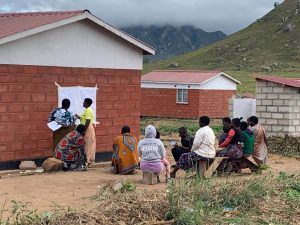
Homemaking in communities recovering from disaster Miscellaneous
2025.
@misc{e04a25b777c34f03812378fdd5c9ca39,

title = {Homemaking in communities recovering from disaster},

author = {Roger Few and Evance Mwathunga and Nicole A. L. Manley and Catherine Jere},

year  = {2025},

date = {2025-11-21},

publisher = {Tyndall Centre for Climate Change Research},

abstract = {This report summarises findings from a collaborative scoping project in Malawi on the topic of homemaking following extreme weather events. We worked with communities that have been displaced temporarily or permanently from their original homes by recent flooding and landslide events. Focus group discussions incorporating visual explorations of ‘home’ were held with communitymembers at sites in four districts of southern Malawi, and their testimonies of impact, response, needs and hopes were complemented with discussions at a workshop with national stakeholders from government, NGOs and universities. Through this exploratory research, we aimed to understand better people's key expectations/aspirations for recreating a sense of home in their new or reconstructed dwellings, the extent to which this has been or is being realised presently, and the conditions required in order to achieve a holistic sense of home. Key in this is a discussion that includes, but goes beyond, questions of the material construction and provision of hard infrastructure to consider more intangible, environmental and symbolic aspects of homemaking. The study engages with an increasing concern globally among agencies that are undertaking resettlement and reconstruction interventions on how to support a more holistic approach to homemaking for disaster-affected communities},

keywords = {},

pubstate = {published},

tppubtype = {misc}

}
Lorenzoni, Irene; Jordan, Andrew James; Sullivan-Thomsett, Chantal; Geese, Lucas
A review of National Citizens’ Climate Assemblies: Learning from deliberative events Journal Article
In: Climate Policy, vol. 25, no. 9, pp. 1546–1562, 2025, ISSN: 1469-3062, (Funding information: Funding for this work was generously provided by a European Research Council Advanced Grant ‘DeepDCarb’ (Grant Number 882601) and the UK ESRC Centre for Climate Change and Social Transformations (CAST, Phases 1 and 2) (ES/S012257/1 and UKRI072).).
@article{1e7b5f9fe6a146fcacc3835aba285d03,

title = {A review of National Citizens’ Climate Assemblies: Learning from deliberative events},

author = {Irene Lorenzoni and Andrew James Jordan and Chantal Sullivan-Thomsett and Lucas Geese},

doi = {10.1080/14693062.2024.2449416},

issn = {1469-3062},

year  = {2025},

date = {2025-11-01},

journal = {Climate Policy},

volume = {25},

number = {9},

pages = {1546–1562},

publisher = {Taylor and Francis},

abstract = {Citizen’s Climate Assemblies (CCA) have been hailed by academics and non-academics as initiatives to improve the legitimacy and efficacy of climate policy governance. Yet it is only recently that such normative claims have been explored empirically. This article reviews the rapidly emerging literature on citizens’ assemblies – and specifically national citizens’ climate assemblies (NCCAs) – and related deliberative events. It critically reflects upon the emerging themes in the literature and assesses their significance for understanding climate policy and governance. It reveals that advocates of assemblies originally claimed that they would: (1) provide an opportunity to improve the input of evidence into policymaking; (2) raise the political awareness of climate action among citizens and elites; and (3) improve the quality of policymaking. However, a much more nuanced picture of their actual role is beginning to appear. It indicates that each assembly is in fact unique in character, shaped by how it combines design features and the contextual conditions in which they operate. This further affects their impact. Views on NCCAs vary significantly: whilst some politicians are dismissive of their contribution, environmental NGOs have generally been the most supportive; the reception among publics has varied greatly; business and industry have only recently begun to discuss their relevance. Although the recommendations of NCCAs are variously implemented, acknowledgement of their wider and deeper impacts is also emerging, alongside proposals for more systematic assessments of their long-term effects. We reflect on future prospects for NCCAs in relation to political institutions, policy processes and wider society.},

note = {Funding information: Funding for this work was generously provided by a European Research Council Advanced Grant ‘DeepDCarb’ (Grant Number 882601) and the UK ESRC Centre for Climate Change and Social Transformations (CAST, Phases 1 and 2) (ES/S012257/1 and UKRI072).},

keywords = {},

pubstate = {published},

tppubtype = {article}

}
Li, Wenzhu; Cunningham, Lee; Osman, Ashraf; Sun, Hongjian
Enhancing Grid Flood Resilience with CFD Fragility Modelling and Risk-Constrained DRL Proceedings Article
In: 2025 IEEE International Conference on Communications, Control, and Computing Technologies for Smart Grids (SmartGridComm), pp. 1–6, IEEE, United States, 2025, (2025 IEEE International Conference on Communications, Control, and Computing Technologies for Smart Grids (SmartGridComm) ; Conference date: 29-09-2025 Through 02-10-2025).
@inproceedings{7cdd4696834748c4bba233a6ace1355d,

title = {Enhancing Grid Flood Resilience with CFD Fragility Modelling and Risk-Constrained DRL},

author = {Wenzhu Li and Lee Cunningham and Ashraf Osman and Hongjian Sun},

url = {https://ieeexplore.ieee.org/xpl/conhome/11204555/proceeding},

doi = {10.1109/SmartGridComm65349.2025.11204561},

year  = {2025},

date = {2025-10-21},

booktitle = {2025 IEEE International Conference on Communications, Control, and Computing Technologies for Smart Grids (SmartGridComm)},

pages = {1–6},

publisher = {IEEE},

address = {United States},

abstract = {Flood-induced failures in power distribution networks compromise grid resilience, while existing resilient control strategies often rely on static risk models and lack integration with physical flood dynamics. This paper presents a hybrid framework that combines Computational Fluid Dynamics (CFD) with Deep Reinforcement Learning (DRL) to enable dynamic risk-aware control under evolving flood conditions. High-resolution flood scenarios are simulated using ANSYS Fluent, where stochastic hydrodynamic parameters are sampled from calibrated Weibull distributions. These parameters are embedded into a Maskable Proximal Policy Optimisation (PPO) agent trained with Conditional Value-at Risk (CVaR) constraints, enabling the learning of risk constrained control policies without requiring real-time CFD computations. This architecture preserves physical fidelity while ensuring dynamic feasibility. When evaluated on the extended IEEE 123-bus feeder, the proposed CFD–DRL controller achieves a 49% reduction in energy not supplied (ENS) and improves CVaR compliance from 85% to 98%, compared to the conventional MPC baseline. The results demonstrate that integrating high-fidelity numerical modelling with scalable learning-based control significantly enhances the adaptability and robustness of flood-resilient grid operations.},

note = {2025 IEEE International Conference on Communications, Control, and Computing Technologies for Smart Grids (SmartGridComm) ; Conference date: 29-09-2025 Through 02-10-2025},

keywords = {},

pubstate = {published},

tppubtype = {inproceedings}

}
Kelley, Douglas I.; Burton, Chantelle; Giuseppe, Francesca Di; Jones, Matthew W.; Barbosa, Maria L. F.; Brambleby, Esther; McNorton, Joe R.; Liu, Zhongwei; Bradley, Anna S. I.; Blackford, Katie; Burke, Eleanor; Ciavarella, Andrew; Tomaso, Enza Di; Eden, Jonathan; Ferreira, Igor José M.; Fiedler, Lukas; Hartley, Andrew J.; Keeping, Theodore R.; Lampe, Seppe; Lombardi, Anna; Mataveli, Guilherme; Qu, Yuquan; Silva, Patrícia S.; Spuler, Fiona R.; Steinmann, Carmen B.; Torres-Vázquez, Miguel Ángel; Veiga, Renata; Wees, Dave; Wessel, Jakob B.; Wright, Emily; Bilbao, Bibiana; Bourbonnais, Mathieu; Gao, Cong; Bella, Carlos M. Di; Dintwe, Kebonye; Donovan, Victoria M.; Harris, Sarah; Kukavskaya, Elena A.; N’Dri, Aya Brigitte; Santín, Cristina; Selaya, Galia; Sjöström, Johan; Abatzoglou, John T.; Andela, Niels; Carmenta, Rachel; Chuvieco, Emilio; Giglio, Louis; Hamilton, Douglas S.; Hantson, Stijn; Meier, Sarah; Parrington, Mark; Sadegh, Mojtaba; San-Miguel-Ayanz, Jesus; Sedano, Fernando; Turco, Marco; Werf, Guido R.; Veraverbeke, Sander; Anderson, Liana O.; Clarke, Hamish; Fernandes, Paulo M.; Kolden, Crystal A.
State of Wildfires 2024–2025 Journal Article
In: Earth System Science Data, vol. 17, no. 10, pp. 5377–5488, 2025, ISSN: 1866-3508.
@article{66f707419fe546cfbd006d55240aac7e,

title = {State of Wildfires 2024–2025},

author = {Douglas I. Kelley and Chantelle Burton and Francesca Di Giuseppe and Matthew W. Jones and Maria L. F. Barbosa and Esther Brambleby and Joe R. McNorton and Zhongwei Liu and Anna S. I. Bradley and Katie Blackford and Eleanor Burke and Andrew Ciavarella and Enza Di Tomaso and Jonathan Eden and Igor José M. Ferreira and Lukas Fiedler and Andrew J. Hartley and Theodore R. Keeping and Seppe Lampe and Anna Lombardi and Guilherme Mataveli and Yuquan Qu and Patrícia S. Silva and Fiona R. Spuler and Carmen B. Steinmann and Miguel Ángel Torres-Vázquez and Renata Veiga and Dave Wees and Jakob B. Wessel and Emily Wright and Bibiana Bilbao and Mathieu Bourbonnais and Cong Gao and Carlos M. Di Bella and Kebonye Dintwe and Victoria M. Donovan and Sarah Harris and Elena A. Kukavskaya and Aya Brigitte N’Dri and Cristina Santín and Galia Selaya and Johan Sjöström and John T. Abatzoglou and Niels Andela and Rachel Carmenta and Emilio Chuvieco and Louis Giglio and Douglas S. Hamilton and Stijn Hantson and Sarah Meier and Mark Parrington and Mojtaba Sadegh and Jesus San-Miguel-Ayanz and Fernando Sedano and Marco Turco and Guido R. Werf and Sander Veraverbeke and Liana O. Anderson and Hamish Clarke and Paulo M. Fernandes and Crystal A. Kolden},

doi = {10.5194/essd-17-5377-2025},

issn = {1866-3508},

year  = {2025},

date = {2025-10-16},

journal = {Earth System Science Data},

volume = {17},

number = {10},

pages = {5377–5488},

publisher = {Copernicus Publications},

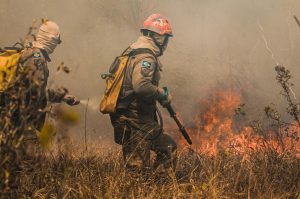
abstract = {Climate change is increasing the frequency and intensity of extreme wildfires globally, yet our understanding of these high-impact events remains uneven and shaped by media attention and regional research biases. The State of Wildfires project systematically tracks global and regional fire activity of each annual fire season, analyses the causes of prominent extreme wildfire events, and projects the likelihood of similar events occurring in future climate scenarios. This, its second annual report, covers the March 2024 to February 2025 fire season. During the 2024–2025 fire season, fire-related carbon (C) emissions totalled 2.2 Pg C, 9 % above average and the sixth highest on record since 2003, despite below-average global burned area (BA). Extreme fire seasons in South America’s rainforests, dry forests, and wetlands and in Canada’s boreal forests pushed up the global C emissions total. Fire C emissions were over 4 times above average in Bolivia, 3 times above average in Canada, and ∼ 50 % above average in Brazil and Venezuela. Wildfires in 2024–2025 caused 100 fatalities in Nepal, 34 in South Africa, and 31 in Los Angeles, with additional fatalities reported in Canada, Côte d’Ivoire, Portugal, and Türkiye. The Eaton and Palisades fires in Southern California caused 150 000 evacuations and USD 140 billion in damages. Communities in Brazil, Bolivia, Southern California, and northern India were exposed to fine particulate matter at concentrations 13–60 times WHO’s daily air quality standards. We evaluated the causes and predictability of four extreme wildfire episodes from the 2024–2025 fire season, including in Northeast Amazonia (January–March 2024), the Pantanal–Chiquitano border regions of Brazil and Bolivia (August–September 2024), Southern California (January 2025), and the Congo Basin (July–August 2024). Anomalous weather created conditions for these regional extremes, while fuel availability and human ignitions shaped spatial patterns and temporal fire dynamics. In the three tropical regions, prolonged drought was the dominant fire enabler, whereas in California, extreme heat, wind, and antecedent fuel build-up were compounding enablers. Our attribution analyses show that climate change made extreme fire weather in Northeast Amazonia 30–70 times more likely, increasing BA roughly 4-fold compared to a scenario without climate change. In the Pantanal–Chiquitano, fire weather was 4–5 times more likely, with 35-fold increases in BA. Meanwhile, our analyses suggest that BA was 25 times higher in Southern California due to climate change. The Congo Basin’s fire weather was 3–8 times more likely with climate change, with a 2.7-fold increase in BA. Socioeconomic changes since the pre-industrial period, including land-use change, also likely increased BA in Northeast Amazonia. Our models project that events on the scale of 2024–2025 will become up to 57 %, 34 %, and 50 % more frequent than in the modern era in Northeast Amazonia, the Pantanal–Chiquitano, and the Congo Basin, respectively, under a medium–high scenario (SSP370) by 2100. Climate action can limit the added risk, with frequency increases held to below 15 % in all three regions under a strong mitigation scenario (SSP126). In Southern California, the future trajectory of extreme fire likelihood remains highly uncertain due to poorly constrained climate–vegetation–fire interactions influencing fuel moisture, though our models suggest that risk may decline in future. This annual report from the State of Wildfires project integrates and advances cutting-edge fire observations and modelling with regional expertise to track changing global wildfire hazard, guiding policy and practice towards improved preparedness, mitigation, adaptation, and societal benefit. Thirteen new datasets and model codebases presented in this work are available from the State of Wildfires Project’s Zenodo community, including updated annual statistics on wildfire extent (Jones et al., 2025; https://doi.org/10.5281/zenodo.15525674), outputs from modelling of fire causality using PoF model (Di Giuseppe, 2025; https://doi.org/10.24433/CO.8570224.v1) and codebase for the extreme event attribution/projections model, ConFLAME (Barbosa et al., 2025a, https://doi.org/10.5281/zenodo.16790787).},

keywords = {},

pubstate = {published},

tppubtype = {article}

}
Hast, Marisa; Baker-Austin, Craig; Lake, Iain; Paromita, Pritiza; Cui, Zhaohui; Jones, Natalia R.; Posen, Paulette; Hughes, Michael J.
Vibrio vulnificus epidemiology and risk factors for mortality in the United States, 2000-2022 Journal Article
In: Infectious Diseases, 2025, ISSN: 2374-4243.
@article{dcaa5fe6e06644ada7ea3bb030e1b077,

title = {Vibrio vulnificus epidemiology and risk factors for mortality in the United States, 2000-2022},

author = {Marisa Hast and Craig Baker-Austin and Iain Lake and Pritiza Paromita and Zhaohui Cui and Natalia R. Jones and Paulette Posen and Michael J. Hughes},

doi = {10.1080/23744235.2025.2559883},

issn = {2374-4243},

year  = {2025},

date = {2025-09-22},

journal = {Infectious Diseases},

publisher = {Taylor and Francis},

abstract = {Background: Vibrio vulnificus is a foodborne and waterborne pathogen causing substantial morbidity and mortality; however, its epidemiology remains poorly understood. To inform prevention and control efforts, we characterized U.S. V. vulnificus epidemiology and identified risk factors for mortality. Methods: For all culture-confirmed V. vulnificus cases reported to the Cholera and Other Vibrio Illness Surveillance (COVIS) system from 2000 to 2022, patient characteristics and medical outcomes were described by foodborne vs. non-foodborne transmission routes. Risk factors for mortality were identified using multivariate logistic regression. Results: Two thousand nine hundred and eighty-nine V. vulnificus cases were reported from 2000 to 2022, including 656 (22%) foodborne and 1,619 (54%) non-foodborne cases. Five-year case total increased 70% from 2000–2004 (n = 487) to 2018–2022 (n = 827). Most patients were male, older and White, with reported underlying health conditions; 2,493 (83%) patients were hospitalized and 692 (23%) died. Number of deaths (260 vs. 200) and fatality rate (40% vs. 12%) were higher among foodborne vs. non-foodborne cases. Mortality was associated with history of liver disease/alcoholism (odds ratio (OR) = 6.5, p < 0.001), age 45–59 (OR = 11.},

keywords = {},

pubstate = {published},

tppubtype = {article}

}
Heaton, Matthew; Perez-Viana, Borja; Emmrich, Peter; Mulat, Belay; Verschoor, Arjan
Understanding farmer preferences to guide crop improvement: The case of grasspea in Ethiopia Journal Article
In: Journal of Development Studies, vol. 61, no. 8, pp. 1221–1241, 2025, ISSN: 0022-0388, (Funding information: This study was supported by the Global Challenges Research Fund. This work was made possible thanks to UKRI-BBSRC funding from the GCRF Agri-Tech Catalyst programme, grant number GCRF-SA-2020-JIC, and GCRF QR funds Rapid Response funds, grant number RR0620-7.).
@article{955a5c3b3d68404b89e364d68e0e071b,

title = {Understanding farmer preferences to guide crop improvement: The case of grasspea in Ethiopia},

author = {Matthew Heaton and Borja Perez-Viana and Peter Emmrich and Belay Mulat and Arjan Verschoor},

doi = {10.1080/00220388.2025.2453519},

issn = {0022-0388},

year  = {2025},

date = {2025-08-01},

journal = {Journal of Development Studies},

volume = {61},

number = {8},

pages = {1221–1241},

publisher = {Routledge},

abstract = {Building climate resilience in agriculture may usefully rely on crop improvement informed by social science studies of farmer preferences. Here, we present the case of grasspea in Ethiopia, a resilient and nutritious legume that can survive conditions where many other crops fail. Excessive consumption however carries the risk of an irreversible, crippling disease, this is possible in the future since the weather extremes that climate change is predicted to bring will create the conditions in which grasspea is one of the food sources that will likely see increased consumption. Crucially, farmers are not fully aware of this risk and may therefore not adopt the low-toxin grasspea that crop scientists have developed and that is about to enter the breeding pipeline. In this study we use focus group discussions, key informant interviews and choice experiments to investigate farmer preferences for grasspea improvement. We confirm that farmers do not place much value on reduced toxicity. Instead, they have strong preferences for other improvements, such as resistance to pests. This suggests that improvements that are needed in future but not yet preferred (i.e. reduced toxicity) should be bundled with improvements that farmers already prefer.},

note = {Funding information: This study was supported by the Global Challenges Research Fund. This work was made possible thanks to UKRI-BBSRC funding from the GCRF Agri-Tech Catalyst programme, grant number GCRF-SA-2020-JIC, and GCRF QR funds Rapid Response funds, grant number RR0620-7.},

keywords = {},

pubstate = {published},

tppubtype = {article}

}
Hsu, Alice; Jones, Matthew W.; Thurgood, Jane R.; Smith, Adam J. P.; Carmenta, Rachel; Abatzoglou, John T.; Anderson, Liana O.; Clarke, Hamish; Doerr, Stefan H.; Fernandes, Paulo M.; Kolden, Crystal A.; Santín, Cristina; Strydom, Tercia; Quéré, Corinne Le; Ascoli, Davide; Castellnou, Marc; Goldammer, Johann G.; Guiomar, Nuno Ricardo Gracinhas Nunes; Kukavskaya, Elena A.; Rigolot, Eric; Tanpipat, Veerachai; Varner, Morgan; Yamashita, Youhei; Baard, Johan; Barreto, Ricardo; Becerra, Javier; Brunn, Egbert; Bergius, Niclas; Carlsson, Julia; Cheney, Chad; Druce, Dave; Elliot, Andy; Evans, Jay; Falleiro, Rodrigo De Moraes; Prat-Guitart, Nuria; Hiers, J. Kevin; Kaiser, Johannes W.; Macher, Lisa; Morris, Dave; Park, Jane; Robles, César; Román-Cuesta, Rosa María; Rücker, Gernot; Senra, Francisco; Steil, Lara; Valverde, Jose Alejandro Lopez; Zerr, Emma
A global assemblage of regional prescribed burn records — GlobalRx Journal Article
In: Scientific Data, vol. 12, 2025, ISSN: 2052-4463, (Code availability: All code used to add global layers to GlobalRx (meteorology, ecological features) and produce all figures are archived in our Zenodo repository (https://zenodo.org/records/13379463). Code used to preprocess global layers, as well as preprocessed global layer datafiles, are also included, where relevant. Acknowledgements: M.W.J. was funded by the UK Natural Environment Research Council (NE/V01417X/1). A.H. was funded by the programme Critical Decade for Climate Change Leverhulme Doctoral Scholars (DS-2020-028). J.R.T. and A.J.P.S. were funded by the European Commission Horizon 2020 (H2020) VERIFY project (no. 776810). SHD was supported by Natural Environment Research Council grant IDEAL Fire (NE/X005143/1) and the project FirEURisk, funded by the European Union’s Horizon 2020 research and innovation programme under grant agreement No 101003890). CAK was supported by the US Department of Agriculture NIFA (award 2022-67019-36435). RC was funded by the Marie Curie Network Grant (award 101086416), and the Tyndall Centre for Climate Change Research. HC was funded by the Westpac Scholars Trust via a Westpac Research Fellowship. YY was funded by KAKENHI (no. JP22H03714 and JP23K24969). GR received support through the ZIM program of the German Ministry of Economy, grant number 16KN052420. E.A.K. was funded by State Assignment Project # FWES-2024-0040. LOA was funded by the São Paulo Research Foundation (FAPESP)(projects: 2021/07660-2 and 2020/16457-3) and by the National Council for Scientific and Technological Development (CNPq) (project 409531/2021-9 and productivity scholarship process: 314473/2020-3). PMF was supported by National Funds from FCT - Portuguese Foundation for Science and Technology, under the project UIDB/04033/2020 (doi: 10.54499/UIDB/04033/2020). N.G. was funded by the European Union through the European Regional Development Fund in the framework of the Interreg V-A Spain–Portugal program (POCTEP) under the FIREPOCTEP+ (Ref. 0139_FIREPOCTEP_MAS_6_E) project and by National Funds through FCT under the projects UIDB/05183/2020, UIDP/05183/2020 and LA/P/0121/2020 (doi: 10.54499/UIDB/05183/2020; doi: 10.54499/UIDP/05183/2020; doi: 10.54499/LA/P/0121/2020) and European Union, Marie Curie Staff Exchange Grant (FIRE-ADAPT 101086416), Pau Costa Foundation [Prat-Guitart]. The authors thank Nicola van Wilgen for assisting with the collation of South Africa National Parks RxB records, and Bernard Lambert for providing RxB records from Pyrénées-Orientales department of south-eastern France.).
@article{0bbe543d5a7f43a8a6b940ecfe718852,

title = {A global assemblage of regional prescribed burn records — GlobalRx},

author = {Alice Hsu and Matthew W. Jones and Jane R. Thurgood and Adam J. P. Smith and Rachel Carmenta and John T. Abatzoglou and Liana O. Anderson and Hamish Clarke and Stefan H. Doerr and Paulo M. Fernandes and Crystal A. Kolden and Cristina Santín and Tercia Strydom and Corinne Le Quéré and Davide Ascoli and Marc Castellnou and Johann G. Goldammer and Nuno Ricardo Gracinhas Nunes Guiomar and Elena A. Kukavskaya and Eric Rigolot and Veerachai Tanpipat and Morgan Varner and Youhei Yamashita and Johan Baard and Ricardo Barreto and Javier Becerra and Egbert Brunn and Niclas Bergius and Julia Carlsson and Chad Cheney and Dave Druce and Andy Elliot and Jay Evans and Rodrigo De Moraes Falleiro and Nuria Prat-Guitart and J. Kevin Hiers and Johannes W. Kaiser and Lisa Macher and Dave Morris and Jane Park and César Robles and Rosa María Román-Cuesta and Gernot Rücker and Francisco Senra and Lara Steil and Jose Alejandro Lopez Valverde and Emma Zerr},

doi = {10.1038/s41597-025-04941-w},

issn = {2052-4463},

year  = {2025},

date = {2025-07-01},

journal = {Scientific Data},

volume = {12},

publisher = {Nature Publishing Group},

abstract = {Prescribed burning (RxB) is a land management tool used widely for reducing wildfire hazard, restoring biodiversity, and managing natural resources. However, RxB can only be carried out safely and effectively under certain seasonal or weather conditions. Under climate change, shifts in the frequency and timing of these weather conditions are expected but analyses of climate change impacts have been restricted to select few regions partly due to a paucity of RxB records at global scale. Here, we introduce GlobalRx, a dataset including 204,517 RxB records from 1979–2023, covering 16 countries and 209 terrestrial ecoregions. For each record, we add a comprehensive suite of meteorological variables that are regularly used in RxB prescriptions by fire management agencies, such as temperature, humidity, and wind speed. We also characterise the environmental setting of each RxB, such as land cover and protected area status. GlobalRx enables the bioclimatic range of conditions suitable for RxB to be defined regionally, thus unlocking new potential to study shifting opportunities for RxB planning and implementation under future climate.},

note = {Code availability: All code used to add global layers to GlobalRx (meteorology, ecological features) and produce all figures are archived in our Zenodo repository (https://zenodo.org/records/13379463). Code used to preprocess global layers, as well as preprocessed global layer datafiles, are also included, where relevant. Acknowledgements: M.W.J. was funded by the UK Natural Environment Research Council (NE/V01417X/1). A.H. was funded by the programme Critical Decade for Climate Change Leverhulme Doctoral Scholars (DS-2020-028). J.R.T. and A.J.P.S. were funded by the European Commission Horizon 2020 (H2020) VERIFY project (no. 776810). SHD was supported by Natural Environment Research Council grant IDEAL Fire (NE/X005143/1) and the project FirEURisk, funded by the European Union’s Horizon 2020 research and innovation programme under grant agreement No 101003890). CAK was supported by the US Department of Agriculture NIFA (award 2022-67019-36435). RC was funded by the Marie Curie Network Grant (award 101086416), and the Tyndall Centre for Climate Change Research. HC was funded by the Westpac Scholars Trust via a Westpac Research Fellowship. YY was funded by KAKENHI (no. JP22H03714 and JP23K24969). GR received support through the ZIM program of the German Ministry of Economy, grant number 16KN052420. E.A.K. was funded by State Assignment Project # FWES-2024-0040. LOA was funded by the São Paulo Research Foundation (FAPESP)(projects: 2021/07660-2 and 2020/16457-3) and by the National Council for Scientific and Technological Development (CNPq) (project 409531/2021-9 and productivity scholarship process: 314473/2020-3). PMF was supported by National Funds from FCT - Portuguese Foundation for Science and Technology, under the project UIDB/04033/2020 (doi: 10.54499/UIDB/04033/2020). N.G. was funded by the European Union through the European Regional Development Fund in the framework of the Interreg V-A Spain–Portugal program (POCTEP) under the FIREPOCTEP+ (Ref. 0139_FIREPOCTEP_MAS_6_E) project and by National Funds through FCT under the projects UIDB/05183/2020, UIDP/05183/2020 and LA/P/0121/2020 (doi: 10.54499/UIDB/05183/2020; doi: 10.54499/UIDP/05183/2020; doi: 10.54499/LA/P/0121/2020) and European Union, Marie Curie Staff Exchange Grant (FIRE-ADAPT 101086416), Pau Costa Foundation [Prat-Guitart]. The authors thank Nicola van Wilgen for assisting with the collation of South Africa National Parks RxB records, and Bernard Lambert for providing RxB records from Pyrénées-Orientales department of south-eastern France.},

keywords = {},

pubstate = {published},

tppubtype = {article}

}
Clapp, Jennifer; Laila, Amar; Conti, Costanza; Hicks, Christina; Vriezen, Rachael; Gordon, Line; Rao, Nitya
Corporate concentration and power matter for agency in food systems Journal Article
In: Food Policy, vol. 134, 2025, ISSN: 0306-9192, (Funding Information: This research was in part supported by the Social Sciences and Humanities Research Council of Canada, grant # 435-2020-0664 (Clapp) and the Canada Reserach Chairs Program (Clapp).).
@article{43696acdeecf4a5d8d2bf349da8f5d20,

title = {Corporate concentration and power matter for agency in food systems},

author = {Jennifer Clapp and Amar Laila and Costanza Conti and Christina Hicks and Rachael Vriezen and Line Gordon and Nitya Rao},

doi = {10.1016/j.foodpol.2025.102897},

issn = {0306-9192},

year  = {2025},

date = {2025-07-01},

journal = {Food Policy},

volume = {134},

publisher = {Elsevier},

abstract = {High levels of corporate concentration and power in agrifood supply chains raise important policy concerns because they can affect food systems in adverse ways. In this paper, we argue that increased corporate concentration and power in food systems has the capacity to undermine people’s agency– that is, their capability to make choices and exercise their voice. We explore three dimensions of the relationship between concentrated corporate power and people’s agency in food systems. First, dominant firms within highly concentrated food system segments can exercise market power, which enables them to earn excess profits – often by charging higher prices, suppressing wages, and weakening livelihood opportunities. Second, dominant agrifood firms have the capacity to shape material conditions within food systems – determining prevailing technologies used in food production, working conditions, levels of processing of packaged food items, and food environments – in ways that can affect people’s choices. Third, dominant agrifood firms can exercise political power by actively pursuing strategies to influence food policy and governance processes via lobbying and other more indirect measures, weakening opportunities for broader democratic participation in food systems governance. Given these potential outcomes, more policy attention should be paid to corporate concentration and its implications for agency within food systems.},

note = {Funding Information: This research was in part supported by the Social Sciences and Humanities Research Council of Canada, grant # 435-2020-0664 (Clapp) and the Canada Reserach Chairs Program (Clapp).},

keywords = {},

pubstate = {published},

tppubtype = {article}

}
Kennedy-Asser, Alan T.; Andrews, Oliver D.; Montgomery, Jill; Jenkins, Katie L.; Smith, Ben A. H.; Lewis, Elizabeth; Birkinshaw, Stephen J.; He, Helen; Pywell, Richard F.; Brown, Matt J.; Redhead, John W.; Warren, Rachel; Robson, Craig; Smith, Adam J. P.; Nicholls, Robert J.; Mullan, Donal; McGuire, Ryan
The role of local knowledge in enhancing climate change risk assessments in rural Northern Ireland Journal Article
In: Climate Risk Management, vol. 48, 2025, ISSN: 2212-0963, (This work was funded by the UK Climate Resilience Programme (NE/W00707X/1 and NE/T013931/1) and from the UK Economic and Social Research Council through the Place-based Climate Action Network (PCAN) (ES/S008381/1) as part of the Rural Resilience Project.).
@article{ea74c9da42a942bdad605b7ff5c969e4,

title = {The role of local knowledge in enhancing climate change risk assessments in rural Northern Ireland},

author = {Alan T. Kennedy-Asser and Oliver D. Andrews and Jill Montgomery and Katie L. Jenkins and Ben A. H. Smith and Elizabeth Lewis and Stephen J. Birkinshaw and Helen He and Richard F. Pywell and Matt J. Brown and John W. Redhead and Rachel Warren and Craig Robson and Adam J. P. Smith and Robert J. Nicholls and Donal Mullan and Ryan McGuire},

doi = {10.1016/j.crm.2025.100702},

issn = {2212-0963},

year  = {2025},

date = {2025-04-01},

journal = {Climate Risk Management},

volume = {48},

publisher = {Elsevier},

abstract = {Climate risk modelling provides valuable quantitative data on potential risks at different spatiotemporal scales, but it is essential that these models are evaluated appropriately. In some cases, it may be useful to merge quantitative datasets with qualitative data and local knowledge, to better inform and evaluate climate risk assessments. This interdisciplinary study maps climatic risks relating to health and agriculture that are facing rural Northern Ireland. A large range of quantitative national climate risk modelling results from the OpenCLIM project are scrutinised using local qualitative insights identified during workshops and interviews with farmers and rural care providers. In some cases, the qualitative local knowledge supported the quantitative modelling results, such as (1) highlighting that heat risk can be an issue for health in rural areas as well as urban centres, and (2) precipitation is changing, with increased variability posing challenges to agriculture. In other cases, the local knowledge challenged the national quantitative results. For example, models suggested that (1) potential heat stress impacts will be low, and (2) grass growing conditions will be more favourable, with higher yields as a result of future climatic conditions. In both cases, local knowledge challenged these conclusions, with discomfort and workplace heat stress reported by care staff and recent experience of variable weather having significant impacts on grass growth on farms across the country. Hence, merging even a small amount of qualitative local knowledge with quantitative national modelling projects results in a more holistic understanding of the local climate risk.},

note = {This work was funded by the UK Climate Resilience Programme (NE/W00707X/1 and NE/T013931/1) and from the UK Economic and Social Research Council through the Place-based Climate Action Network (PCAN) (ES/S008381/1) as part of the Rural Resilience Project.},

keywords = {},

pubstate = {published},

tppubtype = {article}

}
Najafi-Tavani, Zhaleh; Zantidou, Eleni; Leonidou, Constantinos N.; Zeriti, Athina
Business model innovation and export performance Journal Article
In: Journal of International Business Studies, vol. 56, no. 3, pp. 360–382, 2025, ISSN: 0047-2506, (Funding information: Open access funding provided by the Cyprus Libraries Consortium (CLC).).
@article{b6a0b37449be4637958df0ea93a73bbf,

title = {Business model innovation and export performance},

author = {Zhaleh Najafi-Tavani and Eleni Zantidou and Constantinos N. Leonidou and Athina Zeriti},

doi = {10.1057/s41267-023-00645-8},

issn = {0047-2506},

year  = {2025},

date = {2025-04-01},

journal = {Journal of International Business Studies},

volume = {56},

number = {3},

pages = {360–382},

publisher = {Palgrave Macmillian},

abstract = {Although business model innovation (BMI) is generally beneficial for firms, few studies have investigated whether and under what conditions BMI benefits materialize in foreign markets. This research applies two complementary theoretical perspectives to understand the role of BMI in helping firms achieve enhanced performance in export markets. We argue that the effectiveness of the two types of BMI (novelty- and efficiency-centered) is influenced by factors such as relational embeddedness, international experience, and competitive intensity. Using primary data from 263 managers and CEOs from 194 exporting firms, we find that novelty- and efficiency-centered BMI boosts performance by strengthening exporters’ differentiation and cost advantages, respectively. We also show that for firms operating in mildly competitive environments and in a narrow set of countries, novelty-centered BMI is more likely to lead to a differentiation advantage. At the same time, exporters can attain greater cost advantages from efficiency-centered BMI if they have established strong relationships with their export customers/buyers and have been internationally active for a long time. Managers might need to pay close attention to the level of competition, as it can have both positive and negative implications for advantage-driven export performance outcomes.},

note = {Funding information: Open access funding provided by the Cyprus Libraries Consortium (CLC).},

keywords = {},

pubstate = {published},

tppubtype = {article}

}
Menor, I. Oliveras; Prat-Guitart, N.; l. Spadoni, G.; Hsu, A.; Fernandes, P. M.; Puig-Gironès, R.; Ascoli, D.; Bilbao, B. A.; Bacciu, V.; Brotons, L.; Carmenta, R.; de-Miguel, S.; Gonçalves, L. G.; Humphrey, G.; Ibarnegaray, V.; Jones, M. W.; Machado, M. S.; Millán, A.; Falleiro, R. Morais; Mouillot, F.; Pinto, C.; Pons, P.; Regos, A.; de Oliveira, M. Senra; Harrison, S. P.; Pascual, D. Armenteras
Integrated fire management as an adaptation and mitigation strategy to altered fire regimes Journal Article
In: Communications Earth & Environment, vol. 6, 2025, (Data availability statement: Data sharing not applicable to this article as no datasets were generated or analysed during the current study. Funding information: Authors are grateful to the FIRE-ADAPT project (EU grant HORIZON-MSCA-2021-SE-01086416) for support and to the FIRE-ADAPT Consortium for general discussion of ideas during study hubs and exchange secondments. I.O.M. and M.S.M. were supported by NERC grant NE/W00058X/1. P.M.F. was supported by National Funds from FCT - Portuguese Foundation for Science and Technology, under project UIDB/04033/2020 (https://doi.org/10.54499/UIDB/04033/2020). L.B. was supported by the wildE Horizon Europe (GAP- 101081251) project. B.A.B. was funded by the LANDMARC project (European Union’s Horizon 2020 grant agreement No 869367). AR.was supported by the EU-funded ‘Firelogue’ project (Grant agreement ID: 101036534) and a ‘Ramón y Cajal’ fellowship program of the Spanish Ministry of Science and Innovation (RYC2022-036822-I). S.dM. was supported by a Serra Húnter fellowship provided by the Government of Catalonia (Generalitat de Catalunya). G.J.H. was supported by the International Development Research Centre (IDRC), Ottawa, Canada. The views expressed herein do not necessarily represent those of IDRC or its Board of Governors.M.W.J. was funded by the Natural Environment Research Council (NERC; NE/V01417X/1). D.A.P. was supported by the Colombia Ministry of Science and the General System of Royalties project BPIN 2020000100456.).
@article{be8dd018a5204af98454403bd50f6a00,

title = {Integrated fire management as an adaptation and mitigation strategy to altered fire regimes},

author = {I. Oliveras Menor and N. Prat-Guitart and G. l. Spadoni and A. Hsu and P. M. Fernandes and R. Puig-Gironès and D. Ascoli and B. A. Bilbao and V. Bacciu and L. Brotons and R. Carmenta and S. de-Miguel and L. G. Gonçalves and G. Humphrey and V. Ibarnegaray and M. W. Jones and M. S. Machado and A. Millán and R. Morais Falleiro and F. Mouillot and C. Pinto and P. Pons and A. Regos and M. Senra de Oliveira and S. P. Harrison and D. Armenteras Pascual},

doi = {10.1038/s43247-025-02165-9},

year  = {2025},

date = {2025-03-15},

journal = {Communications Earth & Environment},

volume = {6},

publisher = {Nature Research},

abstract = {Altered fire regimes are a global challenge, increasingly exacerbated by climate change, which modifies fire weather and prolongs fire seasons. These changing conditions heighten the vulnerability of ecosystems and human populations to the impacts of wildfires on the environment, society, and the economy. The rapid pace of these changes exposes significant gaps in knowledge, tools, technology, and governance structures needed to adopt informed, holistic approaches to fire management that address both current and future challenges. Integrated Fire Management is an approach that combines fire prevention, response, and recovery while integrating ecological, socio-economic, and cultural factors into management strategies. However, Integrated Fire Management remains highly context-dependent, encompassing a wide array of fire management practices with varying degrees of ecological and societal integration. This review explores Integrated Fire Management as both an adaptation and mitigation strategy for altered fire regimes. It provides an overview of the progress and challenges associated with implementing Integrated Fire Management across different regions worldwide. The review also proposes five core objectives and outlines a roadmap of incremental steps for advancing Integrated Fire Management as a strategy to adapt to ongoing and future changes in fire regimes, thereby maximizing its potential to benefit both people and nature.},

note = {Data availability statement: Data sharing not applicable to this article as no datasets were generated or analysed during the current study. Funding information: Authors are grateful to the FIRE-ADAPT project (EU grant HORIZON-MSCA-2021-SE-01086416) for support and to the FIRE-ADAPT Consortium for general discussion of ideas during study hubs and exchange secondments. I.O.M. and M.S.M. were supported by NERC grant NE/W00058X/1. P.M.F. was supported by National Funds from FCT - Portuguese Foundation for Science and Technology, under project UIDB/04033/2020 (https://doi.org/10.54499/UIDB/04033/2020). L.B. was supported by the wildE Horizon Europe (GAP- 101081251) project. B.A.B. was funded by the LANDMARC project (European Union’s Horizon 2020 grant agreement No 869367). AR.was supported by the EU-funded ‘Firelogue’ project (Grant agreement ID: 101036534) and a ‘Ramón y Cajal’ fellowship program of the Spanish Ministry of Science and Innovation (RYC2022-036822-I). S.dM. was supported by a Serra Húnter fellowship provided by the Government of Catalonia (Generalitat de Catalunya). G.J.H. was supported by the International Development Research Centre (IDRC), Ottawa, Canada. The views expressed herein do not necessarily represent those of IDRC or its Board of Governors.M.W.J. was funded by the Natural Environment Research Council (NERC; NE/V01417X/1). D.A.P. was supported by the Colombia Ministry of Science and the General System of Royalties project BPIN 2020000100456.},

keywords = {},

pubstate = {published},

tppubtype = {article}

}
Douglas, Hunter C.; Revell, Laura E.; Joshi, Manoj; King, Andrew; Harrington, Luke J.; Frame, David J.
Drivers of regional variation in the de-emergence of climate change under negative emissions Journal Article
In: Journal of Climate, vol. 38, no. 5, pp. 1333–1350, 2025, ISSN: 0894-8755, (Data availability statement: The data and code that support the findings of this study will be available at: https://github.com/hdouglas/de-emergence. CMIP6 simulation results are available from: https://esgfnode.llnl.gov/projects/cmip6/ Funding information: H. C. D., L. E. R., L. J. H., and D. J. F. acknowledge funding from the New Zealand Ministry of Business, Innovation and Employment via the Endeavour Fund Whakahura programme (Grant ID: RTVU1906). A. D. K. acknowledges the Australian Government National Environmental Science Program.).
@article{a9a41f80765c4bd9ad377fa7bd81beb3,

title = {Drivers of regional variation in the de-emergence of climate change under negative emissions},

author = {Hunter C. Douglas and Laura E. Revell and Manoj Joshi and Andrew King and Luke J. Harrington and David J. Frame},

doi = {10.1175/JCLI-D-24-0257.1},

issn = {0894-8755},

year  = {2025},

date = {2025-03-01},

journal = {Journal of Climate},

volume = {38},

number = {5},

pages = {1333–1350},

publisher = {American Meteorological Society},

abstract = {A central question of climate change impact assessments is identifying when the signal of change emerges from the noise of natural variability, though to date, this framework has been almost exclusively applied under warming conditions. In this work, we investigate the phenomenon of de-emergence, where temperatures rise beyond a given threshold and subsequently drop back below that threshold as forcing reverses. Large-scale carbon dioxide removal (CDR), also referred to as negative emissions, has been proposed to lower global average temperatures and to mitigate damage to the Earth system, though the regional effects of this have been understudied to date. Here, we analyze the results of eight Earth system models (ESMs) that participated in the CDR Model Intercomparison Project (CDRMIP). Decades after CO 2 concentrations return to preindustrial levels following a gradual quadrupling, the only regions that most models agree to return to preindustrial temperatures are an area across northwestern Eurasia and a small area off the coast of West Antarctica. Around half of the models project de-emergence for areas of North America and East Asia. We investigate potential causes for these patterns and find that the land areas that cool more also exhibit enhanced latent heat flux, net carbon uptake, and precipitation, implying enhanced evapotranspiration. The region off West Antarctica appears to experience a cooling influence from changes to sea ice and meltwater. Both regions experience changes to cloud radiative effects that cause net cooling. The distribution of de-emergence patterns raises questions about the equity and fairness of overshoot scenarios.},

note = {Data availability statement: The data and code that support the findings of this study will be available at: https://github.com/hdouglas/de-emergence. CMIP6 simulation results are available from: https://esgfnode.llnl.gov/projects/cmip6/ Funding information: H. C. D., L. E. R., L. J. H., and D. J. F. acknowledge funding from the New Zealand Ministry of Business, Innovation and Employment via the Endeavour Fund Whakahura programme (Grant ID: RTVU1906). A. D. K. acknowledges the Australian Government National Environmental Science Program.},

keywords = {},

pubstate = {published},

tppubtype = {article}

}
Cataldo, Nicolas Enrique Labra; Schmid, Alejandro Gallego; Muñoz, Edmundo; McLachlan, Carly
Environmental assessment of formal and informal waste treatment of liquid crystal display (LCD) monitors Journal Article
In: Science of the Total Environment, vol. 962, 2025, ISSN: 0048-9697.
@article{8c565e85204348b99bde1041d54f2483,

title = {Environmental assessment of formal and informal waste treatment of liquid crystal display (LCD) monitors},

author = {Nicolas Enrique Labra Cataldo and Alejandro Gallego Schmid and Edmundo Muñoz and Carly McLachlan},

doi = {10.1016/j.scitotenv.2024.178273},

issn = {0048-9697},

year  = {2025},

date = {2025-01-25},

journal = {Science of the Total Environment},

volume = {962},

publisher = {Elsevier BV},

abstract = {In Santiago, Chile, 315,000 liquid crystal display (LCD) monitors are discarded annually. Of this amount, the formal sector of refurbishment and recycling manages only 5 %, creating the conditions for the emergence of informal management systems. This study provides the first comprehensive environmental and circularity assessment of monitor treatment across multiple impact categories, identifying trade-offs associated with formal and informal operations. For this, a life cycle assessment approach is utilised at both the product-level and the municipal management systems level, addressing the processes from the collection of the monitor to its end-of-life. At the product-level, two formal and two informal routes for managing an LCD monitor were evaluated. The results reveal that formal treatment companies have the best environmental performance in all the midpoint categories of ReCiPe, achieving benefits 42,000 times greater than formal disposal for marine eutrophication, and 25 % better than informal flea market traders across all categories. The analysis of management processes attributes most environmental benefits to refurbishment, representing between 76 % and 99 % of the magnitude of the assessed environmental impacts. A sensitivity analysis shows that the environmental performance of an informal trader surpasses that of a formal treatment company when both offer the same expected lifespan for a refurbished monitor and maintain their respective refurbishment rates offered. The municipal-level analysis was carried out through the evaluation of three scenarios. The results indicate that the scenario in which the informal sector cooperates with the formal sector and exclusively dedicates to collecting monitors exhibits superior environmental performance, averaging environmental benefits that are ten times greater than the current scenario and achieving valorisation rates of 22 %, the highest among the evaluated scenarios. The results of this research contribute to the discussion on formalisation and the promotion of the circular economy in the Global South.},

keywords = {},

pubstate = {published},

tppubtype = {article}

}
De, Arijit; Zhao, Qian; Capes, Gerard; Mcguire, Catherine; Lam, Chris; Fullerton, Christopher; Bullock, Simon; Larkin, Alice; Chen, Yu-Wang; Allmendinger, Richard
Handover Report: GrafMarine: Optimization of Solar Power Utilization for Marine Vessels through Data-Driven Modeling and Analysis Book
University of Manchester, United Kingdom, 2025.
@book{fb0ccd972dc94dfbb0724f5331d21964,

title = {Handover Report: GrafMarine: Optimization of Solar Power Utilization for Marine Vessels through Data-Driven Modeling and Analysis},

author = {Arijit De and Qian Zhao and Gerard Capes and Catherine Mcguire and Chris Lam and Christopher Fullerton and Simon Bullock and Alice Larkin and Yu-Wang Chen and Richard Allmendinger},

year  = {2025},

date = {2025-01-20},

publisher = {University of Manchester},

address = {United Kingdom},

abstract = {This handover report documents work that was carried out as part of the Turing Innovation Catalyst Collaborative Research and Development Project undertaken by the University of Manchester and GrafMarine. Aim of the Project: The primary objective of this project was to assess the potential for solar energy capture and storage onboard vessels. A simulation algorithm was designed to understand how solar energy is captured, stored in batteries, and discharged during the voyage across a route with certain number of port calls. The project also explored the impact of different variables such as daylight hours, weather conditions, and the power demands on the solar energy captured, energy discharged from battery and battery level during different sailing legs.},

keywords = {},

pubstate = {published},

tppubtype = {book}

}
Gallego-Schmid, Alejandro; López-Eccher, Camila; Muñoz, Edmundo; Salvador, Rodrigo; Cano-Londoño, Natalia A.; Barros, Murillo Vetroni; Bernal, Daniel Choconta; Mendoza, Joan Manuel F.; Nadal, Ana; Guerrero, Ana Belén
Circular economy in Latin America and the Caribbean: Drivers, opportunities, barriers and strategies Journal Article
In: Sustainable Production and Consumption, vol. 51, pp. 118–136, 2024, ISSN: 2352-5509.
@article{c6f4b777f5ad4a33acf54b0fde179a07,

title = {Circular economy in Latin America and the Caribbean: Drivers, opportunities, barriers and strategies},

author = {Alejandro Gallego-Schmid and Camila López-Eccher and Edmundo Muñoz and Rodrigo Salvador and Natalia A. Cano-Londoño and Murillo Vetroni Barros and Daniel Choconta Bernal and Joan Manuel F. Mendoza and Ana Nadal and Ana Belén Guerrero},

doi = {10.1016/j.spc.2024.09.006},

issn = {2352-5509},

year  = {2024},

date = {2024-11-01},

journal = {Sustainable Production and Consumption},

volume = {51},

pages = {118–136},

publisher = {Elsevier BV},

abstract = {This study assesses for the first time the drivers, opportunities, barriers, and strategies for the transition to a circular economy in Latin America and the Caribbean through a comprehensive systematic review of the current academic literature. A total of 247 articles have been analysed through the lens of the PESTLE framework (Political, Economic, Social, Technological, Legal, and Environmental), coupled with the consideration of the most recognised circular economy strategies (narrowing, slowing, closing, and regenerating) and solutions (the ten R's strategies: refuse, rethink, reduce, reuse, repair, refurbish, remanufacture, repurpose, recycle, and recover). Key drivers identified in the literature include governmental policy shifts in the region towards circular and sustainable practices. These practices have focused on leveraging the abundance and diversity of natural resources and the region's climatic conditions that favour the development of bio-industries, renewable energies, and innovative sustainable materials, reflecting a clear adaptation of circular economy strategies to the specific needs and resources of Latin America and the Caribbean. Similarly, the technological and regulatory progress in pollution prevention and control, although still slow, has driven the implementation of circular economy strategies, making the role of new circular technologies fundamental for the region's sustainability. Barriers mentioned in the articles include limited governmental incentives, inadequate infrastructure for waste management, and the high costs associated with transitioning to circular economy practices, compounded by a lack of general public awareness and engagement. Regarding the circular economy strategies, the reviewed studies predominantly focus on recycling (“closing”) due to the immediate waste management needs of the region, with less emphasis on resource efficiency (“narrowing” and “slowing”) and minimal adoption of regenerative practices due to higher initial investment demands. Recycling and, to a lesser extent, recovery dominate the ten R's strategies discussed in the literature, indicating still a focus on end-of-life approaches in the region, while strategies like reduce, reuse, and repurpose are gaining representation; however, research on repair, refuse, remanufacture, and refurbishment should be the focus of future investigations. Finally, this article provides guidelines and recommendations for future research to facilitate the deployment and management of a sustainable circular economy in the region.},

keywords = {},

pubstate = {published},

tppubtype = {article}

}
Li, Wenzhu; Cunningham, Lee; Schultz, David; Mander, Sarah; Gan, Chin Kim; Panteli, Mathaios
Structural Resilience of Pole-mounted Substations Subjected to Flooding: Generalized Framework and a Malaysian Case Study Journal Article
In: ASCE-ASME Journal of Risk and Uncertainty in Engineering Systems, Part A: Civil Engineering, vol. 10, no. 2, 2024, ISSN: 2376-7642.
@article{66cc47f95802444fa35bf123afcc97a5,

title = {Structural Resilience of Pole-mounted Substations Subjected to Flooding: Generalized Framework and a Malaysian Case Study},

author = {Wenzhu Li and Lee Cunningham and David Schultz and Sarah Mander and Chin Kim Gan and Mathaios Panteli},

doi = {10.1061/AJRUA6.RUENG-1143},

issn = {2376-7642},

year  = {2024},

date = {2024-06-01},

journal = {ASCE-ASME Journal of Risk and Uncertainty in Engineering Systems, Part A: Civil Engineering},

volume = {10},

number = {2},

publisher = {American Society of Civil Engineers},

abstract = {Substations are vital components of electricity supply, representing a weak point in a power network due to their vulnerability to flood events. Pole-mounted substations can effectively mitigate inundation failures by elevating electrical equipment. However, the supporting structures of such substations often are not designed to withstand flood flows, and thus are prone to structural failure. This paper proposes a generalized framework to quantify the structural failure probabilities of pole-mounted substations and to assess their structural resilience to flooding. The generalized framework was applied to a case-study location in Malaysia, where serious flood events are common and pole-mounted substations abound. The study first identifies and quantifies the flood effects on the poles, including pure hydrodynamic forces, the impact of floating debris, debris damming effects, and scouring. The quantified flood effects then are compared with the structural capacity of a typical pole-mounted substation structure and its foundation, to derive a capacity threshold curve for structural failure. The failure probability is illustrated via fragility curves for different flood depths and risk curves for different flood and wind return periods, to assess further the substation’s structural resilience. The aforementioned curves are based on a stochastic distribution of flood depths and velocities represented by a normalized Weibull function. This approach can be adapted easily to depict flood conditions for any given location. Overall, the results of this paper can help stakeholders, including those designing and managing substation structures, to quantify, assess, and further enhance the flood resilience of power-supply networks.},

keywords = {},

pubstate = {published},

tppubtype = {article}

}
Russell, Charlie J. G.; Franco, Aldina M. A.; Atkinson, Philip W.; Väli, Ülo; Ashton-Butt, Adham
Active European warzone impacts raptor migration Journal Article
In: Current Biology, vol. 34, no. 10, pp. 2272–2277.e2, 2024, ISSN: 0960-9822.
@article{91565329413a48a08d6d6d858f0d13e6,

title = {Active European warzone impacts raptor migration},

author = {Charlie J. G. Russell and Aldina M. A. Franco and Philip W. Atkinson and Ülo Väli and Adham Ashton-Butt},

doi = {10.1016/j.cub.2024.04.047},

issn = {0960-9822},

year  = {2024},

date = {2024-05-20},

journal = {Current Biology},

volume = {34},

number = {10},

pages = {2272–2277.e2},

publisher = {Cell Press},

abstract = {Human conflicts can have impacts on wildlife, from direct mortality and environmental damage to the displacement of people, changing institutional dynamics and altering economies.1,2,3 Extreme anthropogenic disturbances related to conflict may act as a barrier to migrating birds and increase the energetic costs of migration.4 On February 24th, 2022, the Russian Federation invaded Ukraine, with targeted attacks on Kyiv and the eastern regions.5 By March 3rd, when the first of 19 tagged Greater Spotted Eagles entered Ukraine on migration, the conflict had spread to most major cities, including parts of western Ukraine.6 We quantified how conflict impacted the migratory behavior of this species using GPS tracks and conflict data from the Armed Conflict Location and Event Data (ACLED) project7,8 in a quasi-experimental before-after control-impact design, accounting for meteorological conditions. Migrating eagles were exposed to conflict events along their migration through Ukraine and exhibited different behavior compared with previous years, using fewer stopover sites and making large route deviations. This delayed their arrival to the breeding grounds and likely increased the energetic cost of migration, with sublethal fitness effects. Our findings provide a rare window into how human conflicts affect animal behavior and highlight the potential impacts of exposure to conflict events or other extreme anthropogenic disturbances on wildlife.},

keywords = {},

pubstate = {published},

tppubtype = {article}

}